
Hal
Live since July 2026Project managers text him all day like a coworker. He files every call, note and document to the right job, answers from the record, and sends each PM a morning brief.
I find where your field-service company is losing time and money. Then I build the digital assistant, AI operating system, web or mobile app, or dashboard that stops it: morning briefs on your phone, alerts before money slips, and estimates in minutes.
Real format · names and numbers changed
in technician time nobody could see. Payroll punches in one system, truck GPS in another. I reconciled them shift by shift at a commercial crane services company.
tracked every day by one assistant. Project managers at an elevator contractor text Hal all day. Live since July 2026.
caught before the PO went out. Hal flagged the gap between a sub’s quote and what was carried in the bid.
from seven team interviews. 326 answers, seven roles. Two builds cover eleven of them.
When he’s out, nobody knows what was promised to whom.
The customer signs with whoever prices first.
An allowance goes in the bid, and margin eats the gap when the real number lands.
Change orders and credits live in someone’s text thread.
Nobody heard the complaint until the renewal didn’t come.
Growth stops at how many good people you can find.
The problem
Jobs live in the field software. Invoices live in accounting. Promises live in email and text threads. The rest lives in people’s heads. I pull it into one company memory you own, then put it to work.
So the business runs for you, not on you.
01Find the leak
I interview your whole team by voice, one person at a time. Then I read every answer, find the patterns nobody can see from one seat, and tell you what breaks first.
“It can take up to a month.”
02Run the day
Every assistant has a name and a job. Hire the ones you need and add more as you grow. They draft, chase and flag. You approve. Your people take on more work without adding headcount.
Project managers text him all day like a coworker. He files every call, note and document to the right job, answers from the record, and sends each PM a morning brief.

Turns a finished field survey into an initial estimate from your own price book, works it out with your estimator over text, then drafts the branded proposal.

Checks your competitors and your market every morning. Flags new territory, contract wins and bid openings, with sources.

Writes the Friday leadership status and the monthly review: what’s working, what’s stuck, and three fixes with evidence.

Every Monday, three researched post ideas from the week’s industry news, drafted in your voice and ready to edit.

Makes outreach calls and answers the phone for a small business, in a voice that sounds like a person, not a script.

Turns an idea into website and app mockups in hours, so you can see it before anyone builds it.
Tell me the job nobody has time for. That’s the next assistant.
Book a call →Hal and Buddy are named after the assistants I built for that client. Yours are built new, around how your company works.
It has provided me with follow ups that it read from my notes. I have found two jobs that I needed to check in on with fire alarms, and it picked up on both. I was able to contact a fire alarm vendor today and get this back on track.
The work shows up on its own
Each one runs on a schedule for a real client today. The format is real. The company, people and numbers are changed.
Every one cites its sources and files a copy to the company memory, so the next report builds on the last.
Competitor alert
Two items from this morning’s competitor check.
Apex’s service page now lists “dedicated crews” in Georgia, North Carolina and South Carolina. Until this week it listed only Texas and Oklahoma. Found in three separate searches returning the same wording.
Source: apexvertical.example — Modernization services
For you: if it’s real, Apex is claiming three states where you already work. One call to a GC in Charlotte would tell us if they’re actually staffed there.
Keystone was awarded the federal courthouse elevator and escalator modernization in Columbus. It’s outside your footprint, but it’s the same buyer you’re pricing in Tennessee.
Sources: federal award notice, state purchasing contract list
Generated by the competitor check. Filed to knowledge/competitors/apex-vertical.md and keystone-lift.md.
Three post ideas from this week’s news scan.
Idea 1
Construction input prices rose again in September. Switchgear, copper wire and steel are all up double digits over last year.
Source: trade press, Oct 2 — read the article
Your angle
Switchgear and copper are in almost every electrical scope before a mod can be tested. An estimate priced six months ago may already be stale.
Copper and switchgear prices are up double digits from a year ago. For elevator modernization, the numbers that move fastest usually aren’t in the elevator scope at all. They’re in the electrical work around it.
We build our building-side estimates to hold up to that swing. How is your team re-pricing jobs that are still months from starting?
Idea 2
Idea 3
Filed to content/ideas/2026-10-05. Three drafts ready to edit and post.
Key accomplishments
Decisions made
Still open
Next week
Read-only summary. Ready to review and forward to leadership.
The record is finally rich enough to check the plan against. Proposals go out in 24 hours to three days, while competitors take a week or more. The same three gaps show up again this month.
Three items worth a look this morning.
Bid opportunity
Pre-bid walk Oct 20. Bids due Nov 12. The scope includes fire-alarm and machine-room electrical, which is your work-by-others lane.
Source: county purchasing portal
Code change
Any mod permitted after Jan 1 is inspected to the new edition. Jobs you’re quoting now may land on either side of that line.
Market
Three conversions announced in your footprint this month. Each one needs its elevators brought up to residential code.
Checked 41 sources. Two could not be reached and are listed in the log.
03Win the work
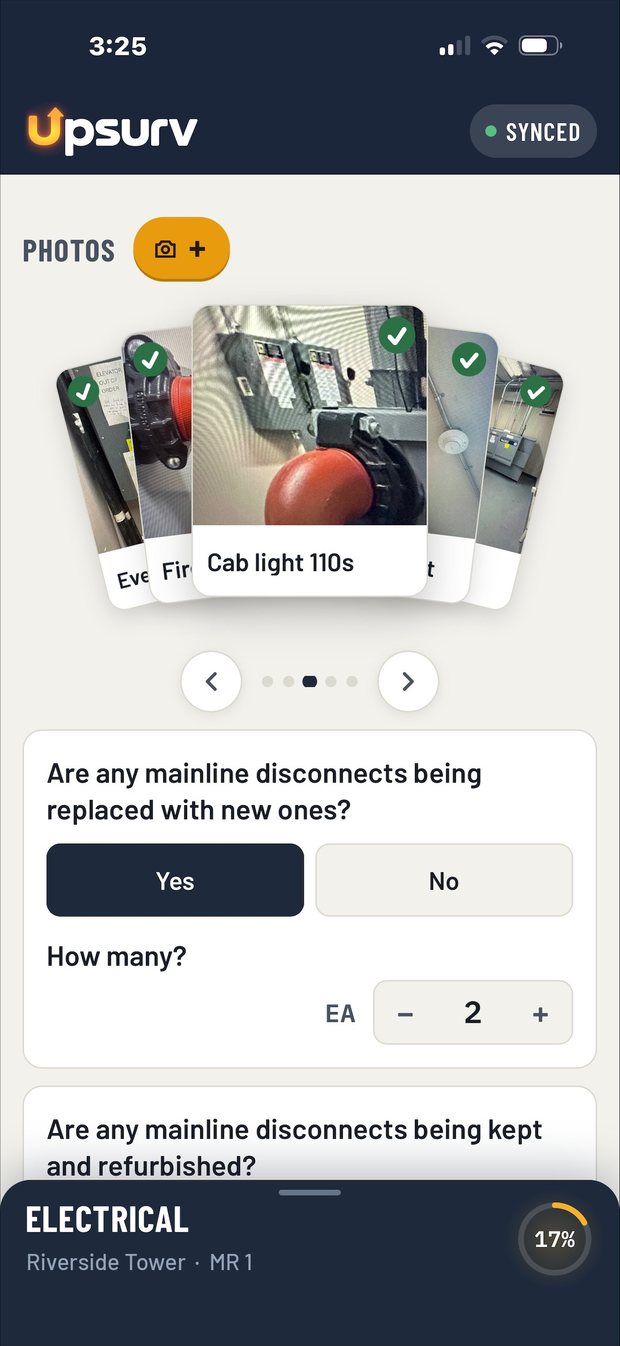
Your surveyor walks the building with the field app. Minutes after they submit, Buddy texts your estimator an initial estimate from your own price book. They work it out together. Buddy drafts the proposal. Your estimator approves and sends it.
Every question, measurement and photo your standard requires, captured on a phone. It works offline, even in a basement machine room.
Buddy prices the survey against your approved price book, in your own estimate template, and flags what needs a human decision.
Change an allowance, set the markup, ask a question. Buddy updates the estimate and keeps a record of every change. The price is always yours.
Your logo, your scope language, your exclusions, the approved price. Ready to read.
Nothing goes to a customer without your yes. The survey, estimate and proposal are filed to the job for whoever picks it up next.
| Electrical (2 disconnects) | $38,400 |
| Fire alarm (allowance) | $9,500 |
| General construction | $61,200 |
| HVAC, machine room | $14,900 |
| Pit and hoistway | $22,750 |
| Total at 18% markup | $172,050 |
Asbestos abatement. Work outside normal hours unless noted.
04See every job
When a text thread isn’t enough, I build the board. These are two I designed for a client, redrawn here with sample data. Power BI too, when that’s the right tool.
05Keep what you know
$184,200 · signed 6/14
Waiting on fire alarm
Owner’s rep, GC, 3 subs
Contract, 2 change orders, 48 photos
Kessler FLS quote in at $9,480. PO held for owner deposit.
Asked Mark if the deposit went out. No answer yet.
Machine-room HVAC passed inspection.
Most clients let me run it: hosting, AI costs and upkeep included. If you already have Claude Team, AWS or Azure, I can build it inside your accounts instead. Always-on assistants your team texts all day, like Hal, run on my platform.
Everything the assistants learn is filed by job in plain documents any system can read, not locked in my software.
Assistants never set prices or contact your customers. Anything that leaves the building waits for your yes.
Every note, update and brief is dated and logged, so you can see what changed and when.
If you ever stop working with me, you keep the complete company memory: every job, note and document.
How we work together
Voice interviews with your whole team, then a findings report that ranks what’s breaking and gives you three ways to fix each one.
Anything from a website fix to a full AI back office: assistants, reports, an app or a dashboard. Fixed scope, fixed price.
I keep it running: updates, fixes, one new capability each month, and a monthly report on what ran and what it saved.
Know exactly what you need fixed? Skip the Walkthrough and go straight to a quote.

About
I’ve spent more than 20 years inside field-service companies: elevators, lawn care, cranes. I built hundreds of reports and the data pipelines behind them, and my findings were certified by the CEOs who acted on them. A report could only show the leak. Now I build the assistants and apps that stop it.
I start with the business problem, not the software. The technology is how I fix it. When you hire Cloud10, you work directly with me, from the first call to the last deliverable.
Questions
I find where your company loses time and money, then I build the fix. That might be an assistant your team texts, a report that shows up on schedule, a field app, or a dashboard. You work with one person from the first call to the last deliverable.
A chat window doesn’t know your jobs, your prices or who promised what. I build the company memory and the jobs that run on it, so the AI works from your records, on a schedule, without anyone having to ask.
No. I connect to what you already use and read from it. Your team keeps working the way they do now.
Wherever it makes sense for you. Most clients let me run it on systems I secure for them. If you already have Claude Team, AWS or Azure, I can build inside your accounts instead. Always-on assistants your team texts all day, like Hal, run on my platform. Either way, everything is filed by job in plain, readable documents, you can ask for a full copy anytime, and if we part ways, you keep all of it.
Yes. I’ve built hundreds of them over 20 years, and when a dashboard is the right fix, I build it. Often the bigger win is something that does the work for your team, not just a report about it.
It depends on the scope. Smaller jobs, like a website fix, start around $2,500. A full AI back office costs more. Every build gets a fixed price before work starts. The Walkthrough starts at $3,500 and is credited toward the build, and the Partner plan starts at $750 a month.
Healthcare and financial services. And any company that wants AI to replace its people. Mine make people bigger.
An honest read on where your money is leaking and what I’d build first. If I’m not the right fit, I’ll tell you.
Book a 30-minute callNot ready to talk? Start with you: fifteen minutes by voice, two findings, free.